

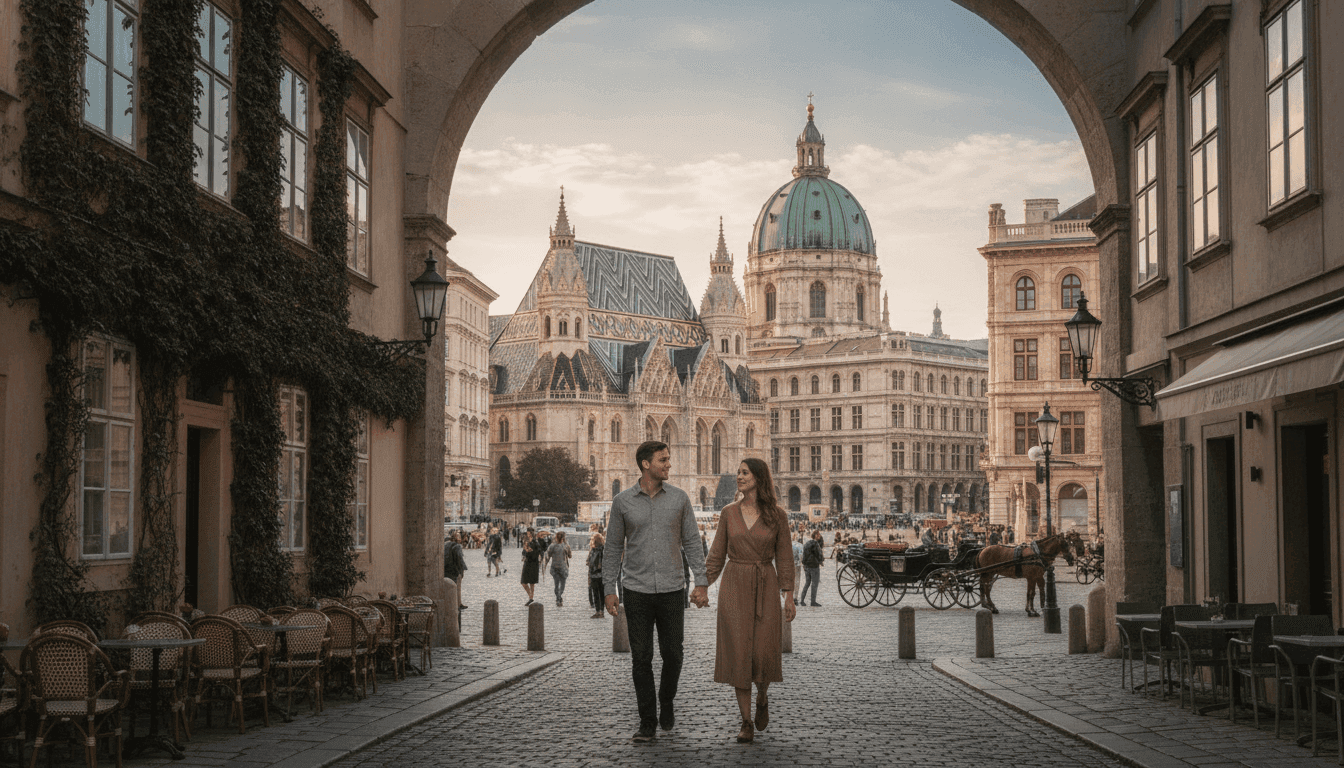


Vienna: Imperial Grandeur and Everyday Elegance
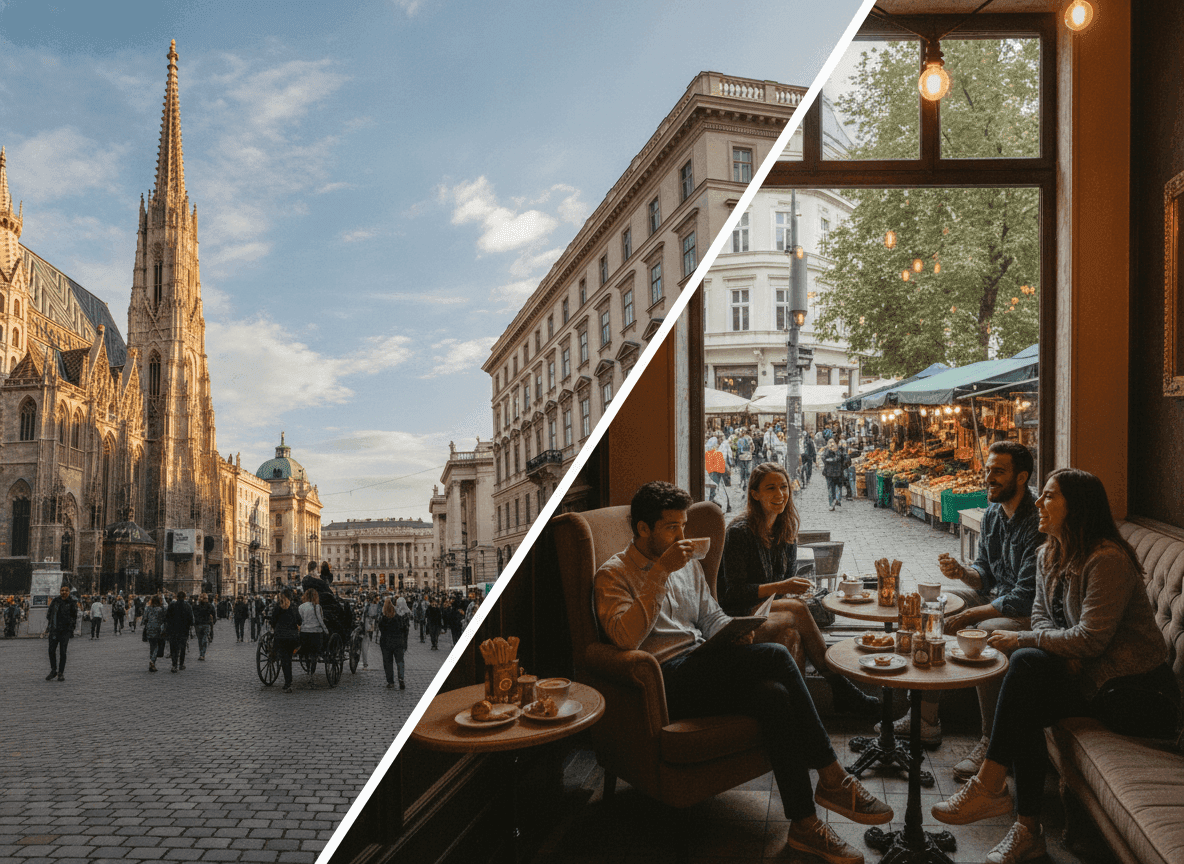
Some cities feel monumental and some feel intimate. But Vienna is, in fact, both. A city with centuries of history at the center of the once vast Habsburg Empire that has left its mark on the town in terms of buildings, streets and coffee houses – all of which are still very much in use. A walk from the cathedral Stephansdom through the 1st district is like a stroll through a museum – though on a human scale.
Many of the famous buildings in Vienna are part of the Ringstrasse, a huge boulevard built around the old city center in the late 19th century. The Ring is roughly a mile long and takes at least half a day to walk, taking in the Vienna State Opera, the Kunsthistorisches Museum, the Natural History Museum, the Austrian Parliament and the Burgtheater, among others.
There is great art to be found in Vienna. The Kunsthistorisches Museum contains one of the greatest collections of Old Masters in the world, while the Belvedere contains Gustav Klimt’s most famous work, The Kiss. The Leopold Museum has a vast and wonderful collection of modern and contemporary Austrian art, while the MUMOK (Museum of Modern Art) has an equally vast collection, but of more international artists. The Albertina is an impressive museum housed in a former imperial palace. It contains everything from paintings by Raphael to works by Monet and Basquiat.
There is so much more to Vienna than impressive sights. The open-air market at the Naschmarkt along the Wienzeile is an absolute highlight. On Saturdays it is especially worth visiting because of the many antique dealers selling there in addition to the usual fresh produce. The seventh district of Vienna, Neubau, also has plenty to offer: here you will find a number of small independent bookshops, design studios as well as trendy coffee shops.
Curious facts: The Austrian capital is for the sixth year in a row declared to be the world’s most liveable city by the Economist Intelligence Unit and is praised especially for stability, for the quality of infrastructure, for education and for culture.
Coffee Houses, Schnitzel and the Art of the Heuriger
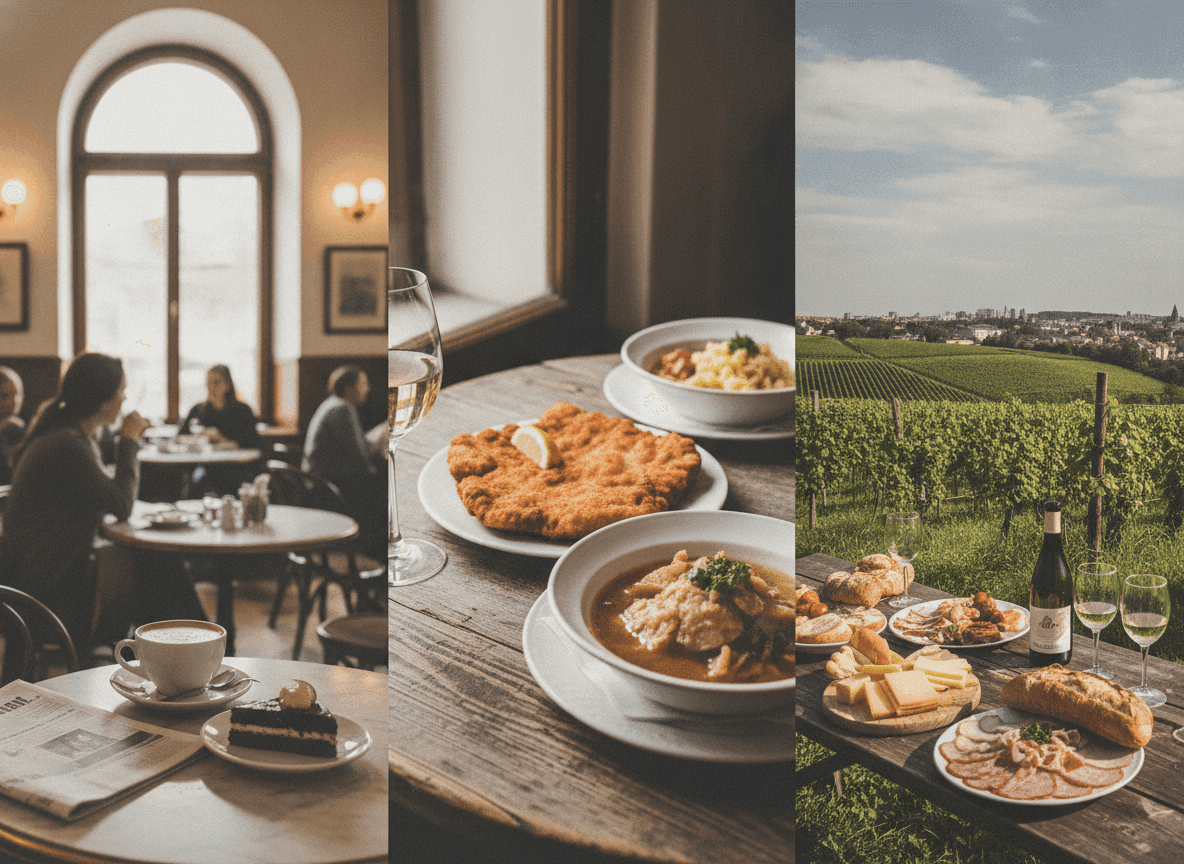
Viennese coffee houses, legendary for generations, are institutions of a different kind: they are part of daily life. In most coffee houses, locals sit all day over one melange (a coffee with steamed milk) and read the newspapers, write letters, meet friends for a chat or simply watch the hustle and bustle around them. Nobody hurries them.
Cafes in Vienna have their own characters. The great traditional coffee houses, such as Cafe Central, which was opened in 1876 and where Freud, Trotsky and Lenin once sat at the marble tables, and the Landtmann on the Ringstrasse, where the politicians and theatergoers of Vienna like to sit, are each individual. The Hawelka, in the first district, has not been changed deliberately for decades and is a real institution.
The food in Vienna is robust and elegant. Of course we have to talk about the Wiener Schnitzel, the thinnest cutlets of veal, pounded, breaded and fried until golden. It is the symbol of Viennese cuisine and should be consumed in a Beisl, a typical Viennese tavern. Another famous dish is the Tafelspitz, boiled prime beef, served with apple horseradish and roasted potatoes. The former Emperor Franz Joseph was particularly fond of this meal and it can still be found in restaurants all over the city.
And then there is the opportunity to indulge in sweet treats. Pastry has a long tradition in Europe and few places can match the creativity of the Viennese patisserie. Most famous is probably the Sachertorte, invented by Franz Sacher in 1832 at the Hotel Sacher in Vienna. The dense chocolate cake with a layer of apricot jam in the middle is one of the most famous pastries in the world and can be found in just about every café in Vienna. But there is more to Viennese pastry than the Sachertorte. A traditional Viennese café also serves Apfelstrudel, Kaiserschmarrn (shredded pancake, mixed with sugar, powdered sugar, jam and walnuts) and Gugelhupf.
Even Vienna’s wine culture has a lot to offer and is underestimated by most people. Vienna is – together with Brussels – one of the few major cities in the world, where you can also drink excellent wines produced within the city limits. In the Heuriger taverns (wine bars) in Grinzing and Neustift am Walde, which are scattered across the hills on the outskirts of the city, they serve fresh young wines from the region, in most cases together with a cold buffet of fresh bread, cheese and cold cuts.
Music, Day Trips and Getting Around Vienna
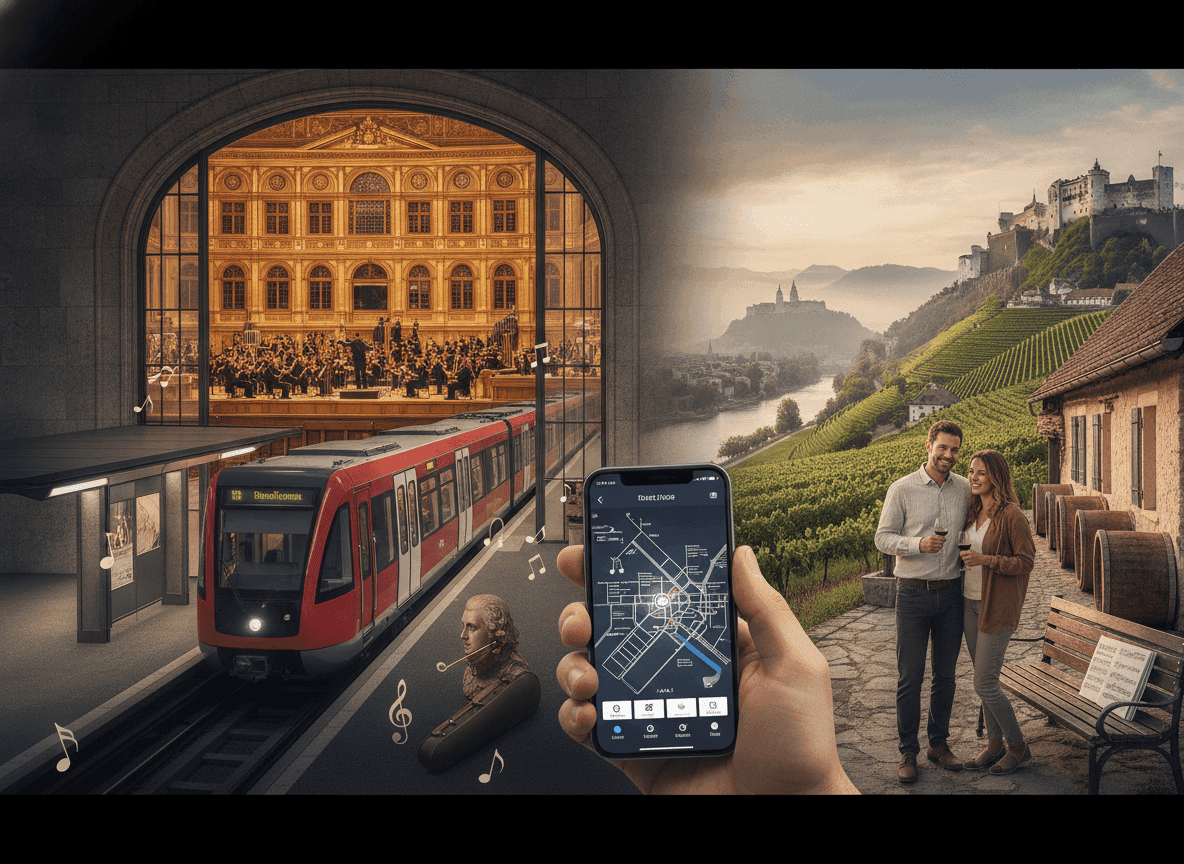
Music is probably more part of the everyday fabric of life in Vienna than in any other city worldwide. Mozart, Beethoven, Schubert, Brahms, Mahler and Strauss all lived and worked in Vienna and are still celebrated today by locals and tourists alike. The Vienna Philharmonic, one of the greatest orchestras in the world, the Vienna State Opera which puts on performances almost every night of the year and the Musikverein in Vienna’s city center with its golden concert hall, where the famous New Year’s Concert is held annually and broadcast to 90 countries around the world – these are just a few examples of how Viennese celebrate their music heritage every day.
Of course, there is so much more to Vienna than classical music. There is an alive and kicking scene of contemporary music, many excellent clubs, a big and good theater scene and also an excellent film festival circuit. The Burgtheater, the national theater on the Ringstrasse, is one of the leading German-language stages in the world.
There are plenty of places to go for a day trip from Vienna and you will find out more about them here. For example, only 12 km from Vienna there is a cloister (Kloster) in Klosterneuburg above the Danube, one of the oldest monasteries in Austria. Even closer to Vienna – less than an hour from the city center by train – there is the town of Krems at the heart of the Wachau, a UNESCO World Heritage Site, with its romantic old town, churches and charming wine cellars where you can taste local wines grown in the terraced vineyards in the surrounding landscape. Another cultural Mecca that can be reached in less than 3 hours from Vienna is Salzburg, the hometown of Mozart, where he was born and where he composed many of his masterpieces, and which fans of the film ‘The Sound of Music’ will recognize immediately as well.
Although in Vienna you can easily get around by public transport, such as by using the U-Bahn (which is very clean and punctual and covers a large area of the city), for tickets there are fairly reasonable prices to be paid. It is therefore recommended to have a mobile phone with an active data connection, in order to check opening hours of museums, or to search for the right tram to get to your destination. If you sort an eSIM for Austria before your trip, you will be online immediately upon your arrival in Vienna and can start exploring the city right away.

eSIM pro Austria
$2.99
Počet dní
Čím více dní vybereš, tím nižší je cena za den

Počet eSIM
Kolik lidí cestuje?
Celkem:
$2.99